

Extending Climbing Gear
Extending climbing gear with a sling, quickdraw or extendable quickdraw has advantages in certain situations.
The disadvantages are fairly minor: you’ll have to carry extra slings/quickdraws, it’ll take a little extra time and it increases your fall potential slightly.
Planning ahead is important. Visualize where you want your rope to run, and extend gear as necessary.
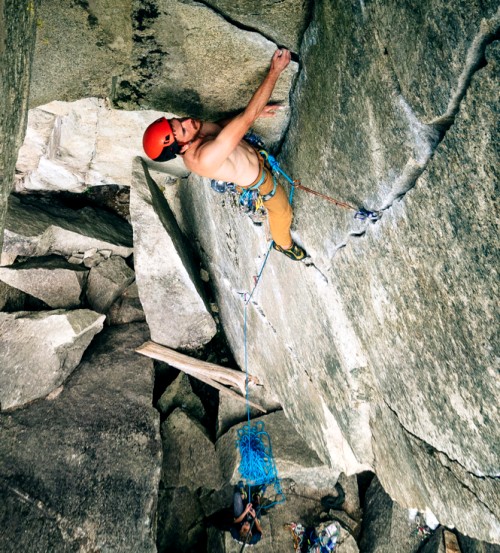
When to Extend Gear
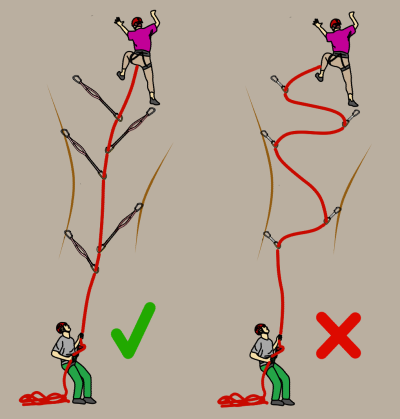
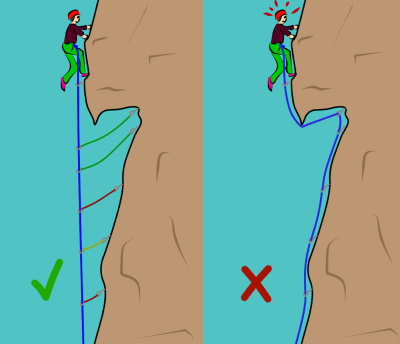
Wandering Routes
When gear placements are not in a straight line, you’ll have to extend them to avoid ‘rope drag’.
You should aim to extend gear so that your rope runs as straight as possible without creating unnecessary fall potential.
For this type of route, it can be worth using half ropes too.
Gear Position
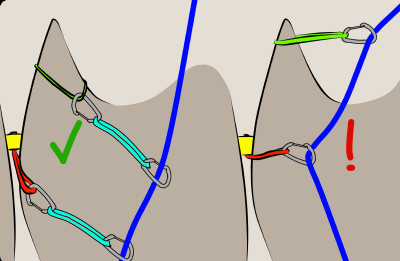
Extending climbing gear helps to keep it in the position that you placed it.
If you don’t extend gear appropriately, slings can lift off, nuts can be pulled out and cams can ‘walk’ out of position. This happens because of movements in your rope as you climb above.
Deep Placements
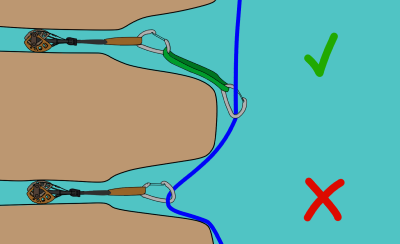
Sometimes, gear must be placed far inside a crack, or around a corner. You’ll need to extend the piece to avoid rope drag. This is especially important if the edge of the crack or corner is sharp.
Sharp Edges
Extend gear to keep your rope away from sharp edges or loose rock.
Rope-Eating Cracks
Cracks at the lip of a roof or overlap are notorious for eating ropes and halting the leader. Even with gear correctly extended beneath the roof, your rope may get stuck if the route continues up low-angled terrain. Sometimes, a nut or hex placed at the lip of the crack can help your rope feed more smoothly, or a piece of gear to one side can guide the rope away from the crack. Another option is to belay immediately after the roof if sufficient gear exists.
Cross-Loading
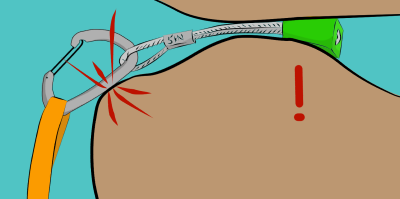
In some situations, carabiners could be ‘cross-loaded’ over an edge. This is most common in deep horizontal placements.
A cross-loaded carabiner could be damaged or break during a fall.
The best solution is to loop a sling through the piece, then clip both ends of the sling to a carabiner.
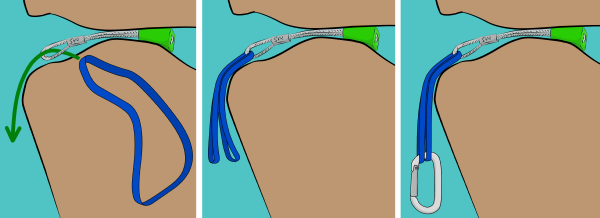
This is better than having a cross loaded carabiner, but it reduces the strength of the sling by 50% or more.
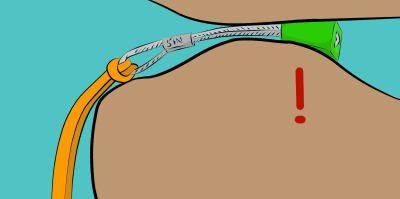
Warning: Girth-Hitching
If you girth-hitch a sling on the wire loop of a nut it is likely to damage or break the sling in a fall.
Related Topics



This article is part of the book – Trad Climbing Basics
E-book (pay what you want)
Paperback
Kindle
Free Sample
Learn how to:
– Place cams, nuts and other trad gear
– Build trad anchors
– Use different belay methods
– Equalize and extend gear effectively
– Understand forces on climbing gear
– Abseil (rappel) safely with a prusik
– Climb with half ropes
– Test rock quality
– Prepare for your first trad lead
Plus much more.