
Advanced Trad Anchors > Minimal Gear Anchors
Advanced Trad Anchors: Minimal Gear Anchors The following minimal gear anchors are great to know in case you reach the top of a pitch without a cordelette, only a meter of rope to spare and…
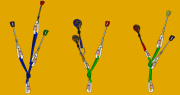
Advanced Trad Anchors: Minimal Gear Anchors The following minimal gear anchors are great to know in case you reach the top of a pitch without a cordelette, only a meter of rope to spare and…
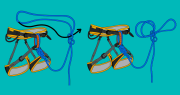
Advanced Trad Anchors: The Equalizing Figure-8 In Trad Climbing Basics, we described methods of building an equalized anchor without the use of slings or a cordelette – great if you’ve used them all during the…
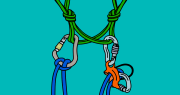
Advanced Trad Anchors: The Quad Anchor What is a Quad Anchor? The ‘Quad Anchor’ is an anchor system which self-adjusts to keep an equal force on each anchor point. It can be better than other…
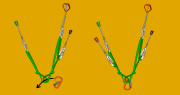
Advanced Trad Anchors: The Sliding-X Self-Equalizing Trad Anchors Advantages The main advantage of using a self-equalizing anchor is that it continues to distribute the load equally between the anchor pieces as the loading direction changes….
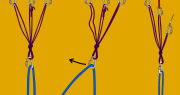
Advanced Trad Anchors : Getting Perfect Equalization In Trad Climbing Basics, we introduced various methods of creating belay master points by tying an overhand knot in a sling or cordelette. These methods are safe, simple…
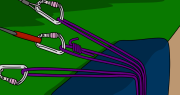
Trad Anchors: Setting Up a Top Rope With the security of an anchored rope above, top-roping is the safest way to climb. A top-roped climber can rest on the rope whenever they are too tired…
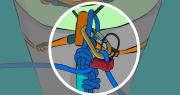
Trad Anchors: Belaying the Follower Belaying from an Anchor Once you’ve climbed a pitch and built an anchor, you will need to belay your partner up. Pull up all the slack rope in the system…
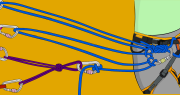
Trad Anchors: Attaching to the Anchor You’ll need to attach yourself to the anchor in a way that you can see your partner as they follow the pitch and brace yourself if they fall. Make…
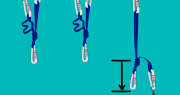
Trad Anchors: Equalizing Gear The Basics Let’s assume you’ve got two incredibly good pieces of gear or two bolts at the anchor. The easiest way to equalize them together is by using a long (120cm…
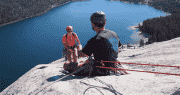
Trad Anchors: Introduction The climb isn’t over when you reach the top. You still need to make an anchor to attach yourself and belay your partner from. You should produce an anchor with at least…
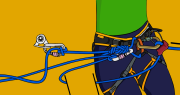
Sport Climbing Anchors – Belaying from the Top For most sport climbs, you will belay from the bottom – just like you would at the indoor gym. However, you should belay from the top of…
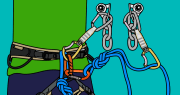
Cleaning a Sport Climbing Anchor ‘Cleaning’ a sport anchor means removing all of your gear from it. Three of the main ways to do this are described below. Which you choose depends on the type…
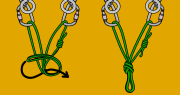
Sport Climbing Anchors – Setting Up a Top Rope With the security of an anchored rope above, top-roping is the safest way to climb. A top-roped climber can rest on the rope whenever they are…
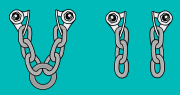
Sport Climbing Anchors – Introduction Many climbs have bolted ‘sport anchors’ at the top. This is the standard for sport climbs worldwide, but is also common at many North American trad climbing venues. These bolted…
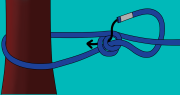
Rock Climbing Knots: The Double Bowline The double bowline is commonly used to secure the end of a rope around a large object such as a tree. It can also be used to tie the…
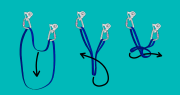
Rock Climbing Knots: The Overhand Knot The overhand knot is useful for:– Joining ropes for abseiling (rappelling)– Creating a master point in a cordelette or sling How to Tie the Overhand Knot Step 1Clip the…
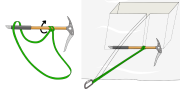
Crevasse Rescue: Snow Anchors You will need to make an anchor on the glacier when:– Performing a crevasse rescue– Belaying/ abseiling across a crevasse or other tricky ground NoteThe anchors described in this section are…
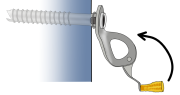
Crevasse Rescue: Ice Anchors How to Place Ice Screws You can place ice screws to make an anchor on a dry glacier, or you might be able to dig through snow on a wet glacier…